

Where Is The Cell Membrane Located In The Animal Cell
This page contents
1. Structure
ii. Properties
3. Functions
Traveling through the extracellular matrix toward the prison cell, the offset cell construction to run into is the plasma membrane. This is a vital element for the cell. Cells die several seconds after the plasma membrane integrity is lost. Cell membranes are concrete barriers, but, as we will see later, perform many other functions. Plasma membrane separates the intracellular environment from the external one. In eukaryotes, and some prokaryotes, there are also internal membranes that course organelles, separating the interior of the organelle from the rest of the cytoplasm.
1. Composition and structure
Components and construction. Membranes are made upward of lipids, proteins and carbohydrates. The construction, organization, as well as concrete backdrop of membranes, mostly rely on amphiphilic lipids, i.e., those having hydrophilic and hydrophobic parts. Lipids are bundled every bit a bilayer with their hydrophobic part in the middle, which is made upward of fatty acrid chains trying to avoid a hydrophilic environment, and their hydrophilic part in contact with water (Figure i). All cell membranes have proteins. There are transmembrane proteins with sequences of hydrophobic amino acids located amongst the lipid fatty chains and two hydrophilic domains, each in one of the membrane surfaces. Proteins anchored to one monolayer of the membrane are also plant, likewise as others spring to lipids. Carbohydrates are not arable in all prison cell membranes, particularly in intracellular membranes. The amount of carbohydrates is college in the external monolayer of plasma membrane, where they are chemically bound to lipids and proteins.


Thousandembranes are large thin sheets. At transmission electron microscopy, transverse view of membranes show a trilaminar organization: 2 outer nighttime lines and ane inner clear line. The nighttime lines correspond to the hydrophilic heads of membrane lipids of both monolayers, respectively, whereas the clear line corresponds to the fat acid chains. This dark-clear-dark organization, known every bit the unit membrane, is establish in every membrane of every cell studied then far. Membrane thickness may exist from 6 to 10 nm, which ways that not all membranes are equal.
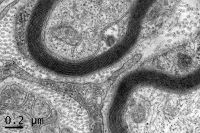
Physiology and construction of cell membranes depend on the types and proportion of lipids, proteins and carbohydrates they contain. They change according to the jail cell type and membrane location. For example, plasma membrane of erythrocytes contains 50 % of lipids, 40 % of proteins and x % of carbohydrates. A similar composition is found in most of the plasma membranes of other cell types, with some exceptions. Myelin (Effigy ii), plasma membrane of glial cells that wraps axons, is composed of lxxx % of lipids and 20 % of proteins, and almost no carbohydrates. Intracellular membranes unremarkably bear witness a higher proportion of proteins than plasma membrane. A remarkable case is the inner mitochondrial membrane, where proteins are up to 80 %. Furthermore, lipids, proteins, and carbohydrates are various, and membranes do not only differ in the proportion of these three molecular groups, just also in the different types of lipids, proteins, and carbohydrates that are present. Moreover, as mentioned above, membranes are in continuous turnover. Therefore they are able to change the proportion and type of molecules to fit the particular cell physiological requirements.
ii. Properties
The physicochemical features of membranes decide their backdrop : a) membranes are fluid layers of lipids and proteins, assuasive lateral movement and rearrangement of molecules, equally if they were a gummy liquid layer; b) membranes are semipermeable, which means that they work as a selective barrier for diffusion of molecules that "want" to cross from one side to another; c) membranes are malleable and flexible, and become cocky-repaired after small breaks, thus recovering their integrity; d) membranes testify continuous molecular turnover that enables different responses to item physiological requirements.
three. Functions
Depending on where they are located, membranes have different functions. They generate and maintain electro-chemic gradients used for several purposes like responding to external stimuli, manual of data, selectively transport of molecules, and synthesize ATP. Membranes make possible intracellular compartments where specific functions are performed and form the nuclear envelope that encloses the genetic material. Many types of receptors are inserted in membranes that allow cells to "sense" molecules of the extracellular environment. Membranes also incorporate many enzymes for metabolic purposes. For instance, cellulose and hyaluronic acid, essential molecules for plant and animal extracelular matrix, respectively, are synthesized in the plasma membrane. Furthermore, there are likewise phosphorylases, ATPases, lipases, and many more than. The integrity of animal tissues relies on cell adhesion molecules, and cell-cell and cell-extracellular matrix adhesions relay on adhesion molecules located in the plasma membrane.
Inorthward the following pages, nosotros volition deal with the master molecules, and then with membrane properties and functions. Finally, the office of membranes in the physiology of organelles will be studied, including vesicular traffic, endocytosis, exocytosis, free energy production, as well every bit the transport of molecules across the lipid bilayer.
Bibliography
Edidin Thou . 2003. Lipids on the borderland: a century of prison cell-membrane bilayers. 2003. Nature reviews in molecular and cell biology. 4:414-418.
Nicolson GL . 2014. The fluid-mosaic model of membrane construction: still relevant to understanding the construction, function and dynamics of biological membranes after more than 40 years. Biochimica and biophysica acta. 1838:1451-1466.
Source: https://mmegias.webs.uvigo.es/02-english/5-celulas/3-membrana_celular.php
Posted by: grahamintinted1951.blogspot.com
0 Response to "Where Is The Cell Membrane Located In The Animal Cell"
Post a Comment