

What Is A Bessel Filter
A Bessel Filter Crossover, and Its Relation to Others
Dennis Bohn, Rane
RaneNote 147 written 1998; revised seven/02 and 4/06
- Crossovers
- Bessel Functions
- Stage Shift
- Grouping Delay
- Halogen Bessels, iii dB Down
Introduction
Ane of the ways that a crossover may be synthetic from a Bessel depression-pass filter employs the standard depression-pass to high-pass transformation. Diverse frequency normalizations tin can be called for best magnitude and polar response, although the linear phase approximation in the passband of the low-laissez passer is non maintained at higher frequencies. The resulting crossover is compared to the Butterworth and Linkwitz-Riley types in terms of the magnitude, phase, and time domain responses.
A Cursory Review of Crossovers
There are many choices for crossovers today, due peculiarly to the flexibility of digital betoken processing. Nosotros now take added incentive to examine unconventional crossover types. Each type has its own tradeoffs betwixt constraints of flatness, cutoff gradient, polar response, and phase response. See [1] and [two] for more than complete coverage of crossover constraints and types. Much of the content of this paper is closely related to previous work past Lipshitz and Vanderkooy in [3].
Our sensitivity to frequency response flatness makes this ane of the highest priorities. It is frequently used every bit a starting betoken when choosing a crossover type.
Cutoff slopes of at least 12 dB per octave are normally chosen considering of limitations in the frequency range that drivers can faithfully reproduce. Even this is less than optimal for most drivers.
Polar response is the combined magnitude versus listening bending from noncoincident drivers [4]. The ideal case is a large lobe in the polar response directly in front end of the drivers, and happens when depression-pass and high-pass outputs are in-phase.
The phase response of a crossover is one of its most subtle aspects, and and so is ofttimes ignored. A purely linear phase shift, which is equivalent to a time delay, is otherwise inaudible, every bit is a small non-linear phase shift. All the same, at that place is evidence that phase coloration is aural in sure circumstances [5], and certainly some people are more than sensitive to it than others.
A first-order crossover is unique, in that it sums with a apartment magnitude response and nada resultant phase shift, although the depression-laissez passer and high-pass outputs are in phase quadrature (90 degrees), and the drivers must perform over a huge frequency range. The phase quadrature that is characteristic of odd-society crossovers results in a moderate shift in the polar response lobe.
In spite of this, third-club Butterworth has been popular for its flat sound pressure and power responses, and xviii dB per octave cutoff gradient.
2nd-order crossovers have historically been chosen for their simplicity, and a usable 12 dB per octave cutoff.
Fourth-order Linkwitz-Riley presents an attractive pick, with flat summed response, 24 dB per octave cutoff, and outputs which are ever in phase with each other, producing optimal polar response.
Steeper cutoff slopes are known to require higher orders with greater phase shift, which for the linear phase example is equivalent to more than time filibuster.
A number of other novel and useful designs exist which should exist considered when choosing a crossover. Generating the high-pass output by subtracting the low-laissez passer output from an appropriately time-delayed version of the input results in a linear stage crossover, with tradeoffs in cutoff slope, polar response, and flatness [one]. Overlapping the pattern frequencies and equalizing the response tin can result in a linear phase crossover [3], with a tradeoff in polar response. A crossover with perfect polar response can exist designed with a compromise in phase response or cutoff slope [vi].
What Is a Bessel Crossover?
The Bessel filter was not originally designed for use in a crossover, and requires small-scale modification to brand information technology work properly. The purpose of the Bessel filter is to achieve approximately linear phase, linear phase being equivalent to a fourth dimension filibuster. This is the all-time phase response from an audible standpoint, bold you don't want to correct an existing phase shift.
Bessels are historically low-laissez passer or all-pass. A crossover yet requires a carve up high-pass, and this needs to be derived from the low-laissez passer. There are different ways to derive a high-laissez passer from a low-pass, but here we discuss a natural and traditional one that maximizes the cutoff slope in the high-pass. Deriving this high-pass Bessel, nosotros notice that it no longer has linear phase. Other derivations of the high-pass can ameliorate the combined phase response, but with tradeoffs.
Two other issues that are closely related to each other are the attenuation at the pattern frequency, and the summed response. The traditional Bessel design is non ideal here. Nosotros can easily alter this by shifting the low or high-laissez passer up or down in frequency. This way, we can adjust the low-pass vs. loftier-laissez passer response overlap, and at the same time achieve a stage difference between the low-laissez passer and high-laissez passer that is nearly constant over all frequencies. In the fourth order instance this is 360 degrees, or essentially in-phase. In fact, the second and fourth society cases are comparable to a Linkwitz-Riley with slightly more rounded cutoff!
Bessel Depression-Pass and High-Pass Filters
The focus of this newspaper is on crossovers derived using traditional methods, which begin with an all-pole lowpass filter with transfer function (Laplace Transform) of the form 1/p(s) ,where p(s) is a polynomial whose roots are the poles.
The Bessel filter uses a p(southward) which is a Bessel polynomial, but the filter is more properly called a Thomson filter, after i of its developers [7]. Still less known is the fact that it was actually reported several years earlier by Kiyasu [8].
Bessel low-laissez passer filters have maximally flat group delay about 0 Hz [ix], so the phase response is approximately linear in the passband, while at higher frequencies the linearity degrades, and the grouping delay drops to zip (run into Fig. 1 and ii). This nonlinearity has minimal impact because it occurs primarily when the output level is low. In fact, the phase response is and so close to a time delay that Bessel depression-laissez passer and all-pass filters may exist used solely to produce a time delay, every bit described in [10].
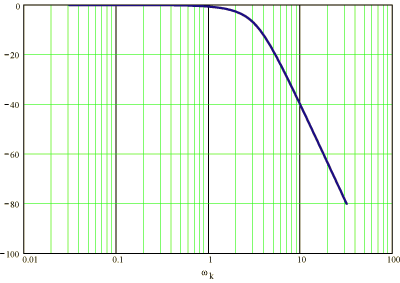
Fig. ane Fourth-Order Bessel Magnitude
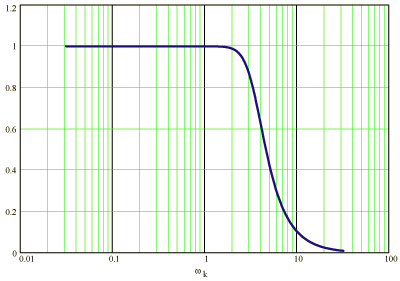
Fig. two Quaternary-Order Bessel Group Delay
The loftier-pass output transfer part may be generated in dissimilar ways, one of which is to replace every example of s in the low-pass with 1/s . This "flips" the magnitude response about the blueprint frequency to yield the high-pass. Characteristics of the low-laissez passer with respect to 0 Hz are, in the high-pass, with respect to infinite frequency instead. A number of other high-pass derivations are possible, only they consequence in compromised cutoff slope or polar response (see [1]). These are beyond the scope of this paper.
This popular method results in the general transfer role (ane); (2) is a quaternary-order Bessel example.
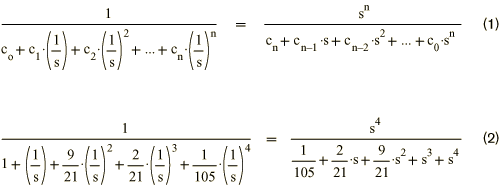
Annotation the reversed coefficient order of the high-pass as compared to the low-laissez passer, once it'due south converted to a polynomial in s, and an added northwardth-society zero at the origin. This zero has a analogue in the low-laissez passer, an implicit northth-order zilch at infinity! The nature of the response of the loftier-pass follows from equation (3) beneath, where s is evaluated on the imaginary centrality to yield the frequency response.

The magnitude responses of the depression-pass and the high-pass are mirror images of each other on a log-frequency scale; the negative sign has no result on this. The stage of the low-pass typically drops near the cutoff frequency from an asymptote of zero as the frequency is increased, and asymptotically approaches a negative value. However, in addition to being mirror images on a log-frequency scale, the stage of the high-pass is the negative of the low-pass, which follows from the negative sign in (iii). And then the stage rises from null at high frequency, and approaches a positive value asymtotically as the frequency is decreased. This results in kickoff curves with similar shape. Whatever disproportion of the southward-shaped phase bend is mirrored between the depression-pass and loftier-pass. See Figure v for a 2nd-social club instance, where the phase curve as well has inherent symmetry.
Ane special example is where the denominator polynomial p(s) has symmetric coefficients, where the nth coefficient is equal to the abiding term; the (n-i)st coefficient is equal to the linear term, etc. This is the case for Butterworth and therefore the Linkwitz-Riley types [3]. A fourth-society Linkwitz-Riley is given as an example in equation (4).

When this is the case, coefficient reversal has no effect on p(southward), and the high-laissez passer differs from the low-pass only in the numerator term due southdue north . This numerator can hands be shown to produce a constant phase shift of 90, 180, 270, or 360 degrees (360 is in-phase in the frequency domain), with respect to the low-laissez passer, when frequency response is evaluated on the imaginary axis. For the second-order case s2=(jw)2= -w2 and the minus sign indicates a polarity reversal (or 180-degree phase shift at all frequencies).
Normalizations
Filter transfer functions are normalized by convention for and are and so designed for

a particular frequency by replacing every example of s in the transfer role by

This has the consequence of shifting the magnitude and phase responses right or left when viewed on a log-frequency calibration. Of form, it doesn't bear upon the shapes of these response curves, since when the transfer functions are evaluated:

where y is a constant multiple of the variable frequency. The group filibuster, being the negative derivative of the phase with respect to angular frequency, is likewise scaled up or down.
This process tin can also be used to conform the overlap betwixt the depression-pass and high-pass filters, so equally to modify the summed response. After this is done, the filters are withal normalized equally before, and may be designed for a particular frequency. Adjusting the overlap will be done hither with a normalization constant u, which will be applied equally simply oppositely to both the low-pass and high-pass. In the low-pass, s is replaced past (s/u), and in the loftier-laissez passer, s is replaced by (su). The depression-pass response is shifted right (u > one) or left (u < 1) when viewed on a log frequency scale, and the high-laissez passer response is shifted in the contrary direction.
These overlap normalizations may exist based on the magnitude response of either output at the pattern frequency, chosen for the flattest summed response, for a particular phase shift, or any other benchmark.
Normalization influences the symmetry of p(s), only perfect symmetry is not achievable in general. This means that it will not e'er be possible to brand the depression-laissez passer and high-pass phase response differ exactly by a constant multiple of 90 degrees for some normalization. The state of affairs can exist clarified by normalization for cn = 1, as washed past Lipshitz and Vanderkooy in [1] and [5], where c0 = 1 for unity gain at 0 Hz. This class reveals any inherent asymmetry. Equation (vi) shows the general depression-pass, while (vii) is the quaternary-gild Bessel denominator. Notation that it becomes nearly symmetric, and relatively similar to the Linkwitz-Riley in (iv).
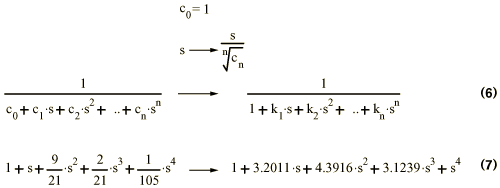
Stage-Matched Bessels
The textbook low-pass Bessel is oftentimes designed for an estimate time delay of

rather than for the common -iii dB or -six dB level at the design frequency used for crossovers. This design will be used equally a reference, to which other normalizations are compared. The low-pass and loftier-pass have quite a lot of overlap, with very little attenuation at the design frequency, every bit shown in Figure iii, for a second-order Bessel with one output inverted.
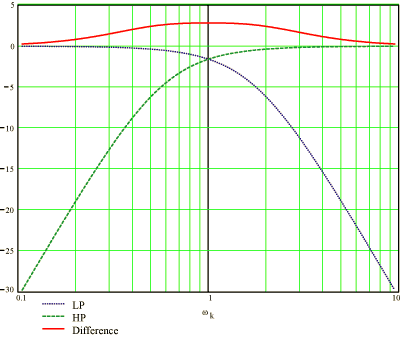
Fig. 3 Second-Club Bessel Crossover
Bessel polynomials of degree three or higher are not inherently symmetric, but may be normalized to be nearly symmetric by requiring a stage shift at the blueprint frequency of 45 degrees per club, negative for the low-pass, positive for the high-pass. This results in a fairly abiding relative phase between the depression-laissez passer and high-laissez passer at all other frequencies. Equation (viii) shows an equation for deriving the normalization constant of the 4th-order Bessel, where the imaginary part of the denominator (7) is set to zero for 180-degree phase shift at the design frequency.

This normalization is not new, merely was presented in a slightly different context in [5], with a normalization abiding of 0.9759, which is the square of the ratio of the stage-friction match u in equation (8) to the u unsaid by equations (6) and (7), the fourth root of 1/105.
Since the phase nonlinearity of the high-pass is now in the passband, the crossover resulting from the sum of the two approaches phase linearity just at lower frequencies. This doesn't foreclose it from being a useful crossover.
The summed magnitude response of the Bessel normalized by the 45-degree criterion is fairly apartment, within 2 dB for the second-gild and fourth-order. We may adjust the overlap slightly for flattest magnitude response instead, at the expense of the polar response. Figures four-vi show the results of 4 normalizations for the second-social club filter. The -three dB and phase-match normalizations are illustrated in Figures 5 and half-dozen. Note that for the second-club phase-lucifer design, low-pass and high-pass group delays are exactly the same.
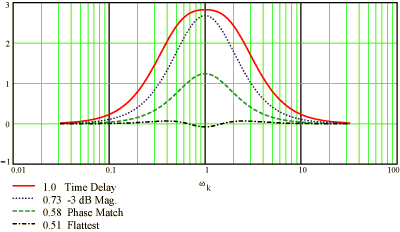
Fig. 4 Comparison of 2nd-Order Bessel Sums
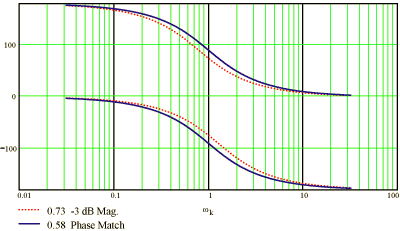
Fig. v Comparing of Second-Guild Stage
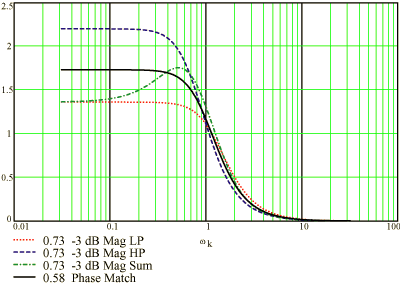
Fig. 6 Second-Order Group Delay
The fourth-order is illustrated in Figures 7-9, Figure vii being a 3-D plot of frequency response versus normalization. Figure 8 shows four cases, which are cross-sections of Figure vii. The phase-match case has skillful flatness as well every bit the best polar response. The fourth-order Linkwitz-Riley is very similar to the Bessel normalized by 0.31. The third-social club Bessel magnitude has comparable behavior.
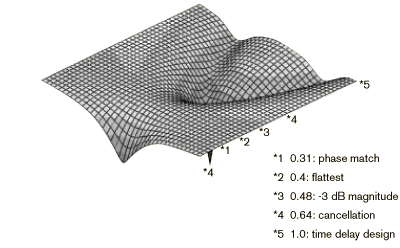
Fig. seven Summed Fourth-Order Bessel Frequency Response vs. Normalization. Normalization values are relative to fourth dimension delay design.
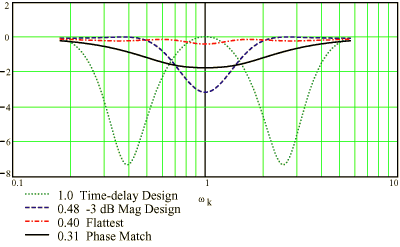
Fig. 8 Summed Fourth-Order Responses
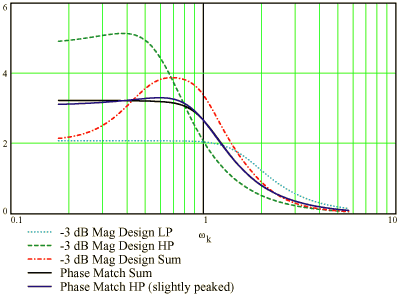
Fig. 9 Fourth-Order Sum Group Delays
In a real application, phase shifts and amplitude variations in the drivers will crave some adjustment of the overlap for best functioning. The sensitivity of the crossover response to normalization should be considered [2].
Comparing of Types
Butterworth, Linkwitz-Riley, and Bessel crossovers may be thought of every bit very separate types, while in fact they are all particular cases in a continuous space of possible crossovers. The dissever and summed magnitude responses are singled-out simply comparable, as can be seen by graphing them together (Figure 10). The Bessel and Linkwitz-Riley are the nearly similar. The Butterworth has the sharpest initial cutoff, and a +iii dB sum at crossover. The Linkwitz-Riley has moderate rolloff and a flat sum. The Bessel has the widest, most gradual crossover region, and a gentle dip in the summed response. All responses converge at frequencies far from the blueprint frequency.
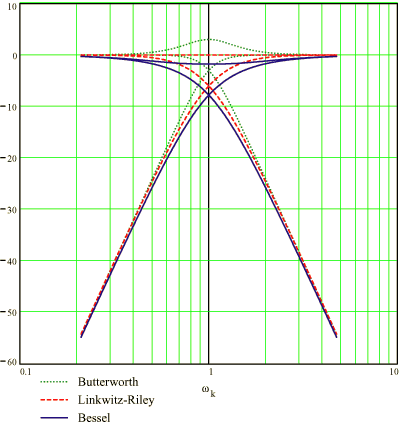
Fig. ten Quaternary-Order Magnitudes
The phase responses likewise look like, but the amount of peaking in the group delay curve varies somewhat, every bit shown in Effigy eleven. There is no peaking in the Bessel depression-laissez passer, while there is a little in the high-pass for orders > ii. The summed response has merely a little peaking. The grouping delay curve is directly related to the behaviour in the fourth dimension domain, equally discussed in [xi]. The nigh overshoot and ringing is exhibited by the Butterworth design, and the to the lowest degree by the Bessel.
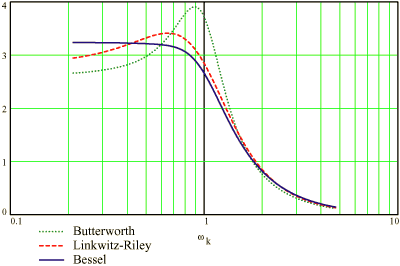
Fig. 11 Fourth-Gild Group Delays
Often when discussing crossovers, the low-pass step response is considered by itself, while the high-pass and summed step response is usually far from ideal, except in the case of the linear phase crossover; this has been known for some time [12], but step-response graphs of higher-club crossovers are generally avoided out of good taste!
Table 1 gives Bessel crossover denominators normalized for time delay and phase friction match. Notation the near-perfect symmetry for the (last iii) phase-friction match cases.
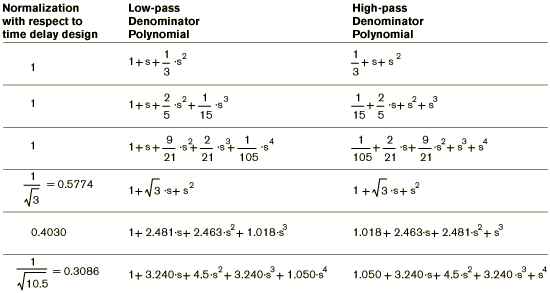
Table i - Bessel Crossovers of Second, 3rd, and 4th-Order, Normalized Beginning for Time Delay Blueprint, and so for Stage Match at Crossover
Rane's Bessel Crossover at -3 dB
Rane's Bessel crossover in Halogen is gear up for phase match between low-pass and high-pass. This minimizes lobing due to driver separation, and too results in a pretty apartment combined response. Another popular option is to accept the magnitude response -three dB at the design frequency. If -iii dB is desired at the setting, the frequency settings demand to be inverse by particular factors.
You volition need to enter divide values for low-pass and high-pass: multiply the low-pass and loftier-pass frequencies by the post-obit factors:
Crossover Type | Low-Pass | High-Pass |
| Second-Lodge (12 dB/octave) | ane.272 | 0.786 |
| Third Order (18 dB/octave) | ane.413 | 0.708 |
| Fourth Gild (24 dB/octave) | i.533 | 0.652 |
For example, for a 2nd-club depression-pass and high-pass set to 1000 Hz, set the low-pass to 1272 Hz and the high-pass to 786 Hz.
Summary
Information technology is seen that a Bessel crossover designed every bit described to a higher place is not radically different from other common types, particularly compared to the Linkwitz-Riley. It does not maintain linear stage response at higher frequencies, but has the near linear phase of the three discussed, along with fairly good magnitude flatness and minimal lobing for the even orders. It is one proficient choice when the drivers used have a wide plenty range to back up the wider crossover region, and when adept transient behaviour is desired.
References
- S.P. Lipshitz and J. Vanderkooy, "A Family unit of Linear-Phase Crossover Networks of Loftier Slope Derived past Time Filibuster", J. Aud. Eng. Soc, vol 31, pp2-xx (1983 January/Feb.).
- Robert M. Bullock,3, "Loudspeaker-Crossover Systems: An Optimal Pick," J. Audio Eng. Soc, vol. thirty, p486 (1982 July/Aug. )
- S.P. Lipshitz and J. Vanderkooy, "Apply of Frequency Overlap and Equalization to Produce Loftier-Slope Linear-Stage Loudspeaker Crossover Networks," J. Audio Eng. Soc, vol. 33, pp114-126 (1985 March)
- South.H. Linkwitz, "Active Crossover Networks For Non-Coincident Drivers, " J. Audio Eng Soc, vol. 24, pp 2-8 (1976 Jan/Feb.).
- South.P. Lipshitz, Grand Pocock and J. Vanderkooy "On the Audibility of Midrange Phase Distortion in Audio Systems," J. Audio Eng. Soc, vol 30, pp 580-595 (1982 Sept.)
- Southward.P. Lipshitz and J. Vanderkooy, "In Phase Crossover Network Design," J. Audio Eng. Soc, vol 34, p889 (1986 Nov.)
- W.East. Thomson, "Delay Networks Having Maximally Flat Frequency Characteristics," Proc IEEE, role 3, vol. 96, Nov. 1949, pp. 487-490.
- Z. Kiyasu, "On A Design Method of Delay Networks," J. Inst. Electr. Commun. Eng., Nippon, vol. 26, pp. 598-610, August, 1943.
- L. P. Huelsman and P. Eastward. Allen, "Introduction to the Theory and Design of Active Filters," McGraw-Hill, New York, 1980, p. 89.
- Dennis G. Fink, "Fourth dimension First and Crossover Design," J. Audio Eng Soc, vol. 28:nine, pp601-611 (1980 Sept)
- Wieslaw R. Woszczyk, "Bessel Filters as Loudspeaker Crossovers," Audio Eng. Soc. Preprint 1949 (1982 October.)
- J.R. Ashley, "On the Transient Response of Ideal Crossover Networks," J. Audio Eng. Soc, vol ten, pp241-244 (1962 July)
Presented at the 105th Convention of the Audio Engineering Society, San Francisco, CA, 1998
 "A Bessel Filter Crossover, and Its Relation to Others" This note in PDF.

What Is A Bessel Filter,
Source: https://www.ranecommercial.com/legacy/note147.html
Posted by: grahamintinted1951.blogspot.com
0 Response to "What Is A Bessel Filter"
Post a Comment